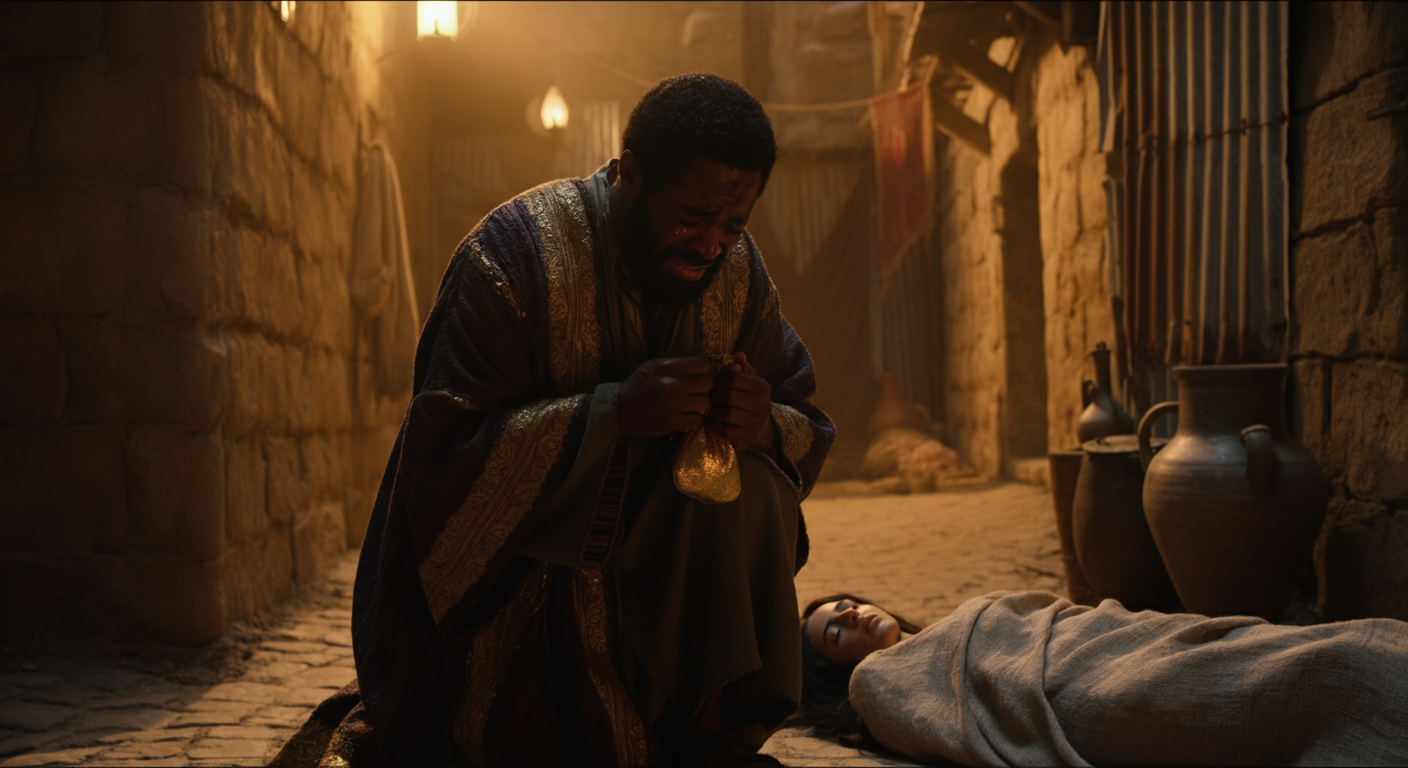
Manse Musa blinked at the light of the bright sun, and blinked back the wetness in his eyes. He had cradled Lulu in his arms for a long, long time. Until he had felt her body go cold and stiff. His retinue had stood outside, waiting and wondering why their great Manse, their great King, the richest man in all the land, had stayed so long in a dilapidated hovel in the poorest part of the great city of Mecca. But now, he had come out of the poor, dark hut, and stood there blinking against the bright sunshine. Now they could continue with their hajj and complete their pilgrimage.
Musa went up to Amin, his chief aide and confidante. His voice cracked as he spoke. “My friend. She is in there. Give her a funeral fit for the wife of Manse Musa.” “You mean Lulu is…” He couldn’t bring himself to finish the sentence. “She is no more,” Musa said.
Amin laid a hand on his shoulder. “It is the will of Allah, my friend.”
The rage burned hot in Musa’s chest. “Not the will of Allah. The folly of man. We will bury her and return home today.”
“But what about the gold for her father?” He nodded at the caravan of camels. Twenty two beasts, bearing twenty two bags, each filled with coins of gold. Each bearing the likeness of Musa. “Will you give it to him? You have fulfilled your promise.”
Musa’s eyes shot up to the Kaliph’s palace, gleaming white atop the hill overlooking the city, a pearl on a sand dune. It reminded him of the finest pearl that had ever sat within it. Lulu. They had grown up together. He, the son of Haroun, the Kaliph’s major domo, and she, the Kaliph’s only child. He was the only person whose company she enjoyed after her mother passed away giving birth to the Kaliph’s second child, a boy who died along with his mother.
The two had been inseparable. He had taught her how to climb trees, and to sling a shot, and to catch the little beetles that glowed at night. She had taught him how to draw, and how to write, and how to speak the many languages that a Kaliph’s daughter was expected to know. Neither the Kaliph nor Haroun thought much of their childish friendship. They were only too aware of the roads that life takes, that often change childhood warmth into grown-up coldness. As they came of age, they were sure, they would realize the differences that stood between them were not easily overcome. He was a slave. She was royal. He was black. She was Arab. He had nothing. She had everything. But none of what they had expected came to pass. Too late, both fathers realized that childhood friendship had bloomed into young love. Lulu flatly refused the hand of Imraan, the neighbouring Kaliph’s son. Questions were asked. Threats were made. It was learned that her heart belonged to another, and she would never go against her heart. “She is too much like her mother,” her father said. “Stubborn as a donkey. But still, Musa is a slave. And what has to be, has to be.” The sentence was passed. Musa was to be put to death. But Lulu’s threat to end her own life meant that exile became the new sentence. And Musa, finally growing tired of watching his own life pass before his eyes as though it were someone else’s, found courage and spoke bold words.
“Kaliph. May Allah grant you long life. You have sent me into exile as punishment for the normal course of events. But I have this question to ask. What is the brideprice that you have set for your daughter?”
“Eleven bags of gold. Why?”
“If I were to return with twice that amount, and a title that would make me worthy of her, would you take me for your son?”
The howls of laughter that filled the Kaliph’s chamber did not change the stern look on Musa’s face. The Kaliph nodded. “That is impossible. But if you do it, you may have her.”
“Then I will go into exile. In twenty two years, I will return with twenty two bags of gold, and I will claim Lulu’s hand.”
More peals of laughter ushered him out of the Kaliph’s court, and continued in his ears as he traveled west, across the Great Desert, with nothing other than a new name, and the memory of his father’s contemptuous gaze as he refused to give him his hand in farewell. That, and the image of Lulu’s face – an image he etched into his memory. An image that pushed him to work harder than any in the gold fields of Marwa. The image that drove him to rise to the rank of translator then advisor to its ruler, Mansa Yusuf. The same image that made him broker peace when the warring clans tore the city apart after Yusuf’s death. The same image that made him unwillingly accept the title of Manse and reclaim his birth name – Musa – after the people acclaimed him as their ruler. It was Lulu’s face that made him open new routes across the Great Desert, quelling the desert raiders and making travel safe for all. He saw her face as he hired former slaves in his gold mines, giving them the dignity of being men who worked for pay, and making him richer than any man who had ever walked the earth. And it was her face he saw when, twenty two years after leaving Mecca, he announced to his ministers that he was going to make a hajj to the great city, and that he would return with a wife, and finally give them the assurance they wanted about an heir to the throne.
It had taken him a month to cross the desert, and two days to find Lulu in Mecca. She no longer lived in the palace. Her old father had lost his mind, and spent his days cooped up in his bedchambers. An old servant, a friend of Musa’s deceased father, had pointed him towards the hovels on the edge of the city. There, he would find her.
She had lain in a run down hut, wasting away, ravaged by fever. When he entered and saw her sunken cheeks and sallow skin, it had taken a moment to realize that the image in his mind was no more. He took her hand in his, and her big brown eyes flickered open, like someone awaking from a dream.
“You came back.”
“Yes.”
“I searched for you. After you left, I ran away. I looked everywhere for you. I crossed the desert. I searched in all the kingdoms. But nobody knew of you.”
“I changed my name.”
“The journey was hard. I returned with this fever. It never went away. But I knew that I could not die before seeing you again.”
“No, Lulu. I have your bride price.”
“And you have my heart.” She raised a limp hand and caressed his cheek. Then her hand fell away, and she breathed no more.
Musa stared at the Kaliph’s palace. A pearl that had lost its lustre. As worthless as the desert sand on which it stood.
“What will we do with the gold?” Amin asked again.
Musa’s eyes turned from the faded pearl atop the hill, to the sacks of gold on the camels. “Pour it on the streets.”
“What?”
“Pour it on the streets. It will never bring her back. Pour it all.”
THE END.
Join the Conversation
Thoughts on this chapter? Head over to Substack to leave a comment, reply to other readers, and follow along as the story unfolds.
Discuss on Substack ↗